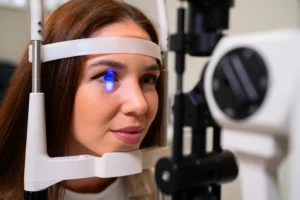

If bright lights suddenly bother you more than they used to, or reading has become unexpectedly difficult despite good glasses — you may be experiencing the early signs of a posterior subcapsular cataract.
This complete guide explains exactly what posterior subcapsular cataract is, why it develops, who is most at risk, and what treatment options are available — in clear, straightforward language designed to help you make informed decisions about your eye health.
What Is a Posterior Subcapsular Cataract?
A posterior subcapsular cataract (PSC) is a specific type of cataract that forms at the back surface of the eye’s natural lens — directly beneath the posterior lens capsule, which is the thin membrane that encloses the lens.
Unlike other cataracts that develop in the lens nucleus (centre) or cortex (outer layers), PSC forms at a particularly critical optical location. Because it sits directly in the path of light travelling to the retina, even a small area of cloudiness at this position can significantly affect vision — often more than a much larger opacity in other parts of the lens.
PSC is one of the three main types of cataracts — alongside nuclear cataracts and cortical cataracts — and it is considered one of the faster-progressing forms when left untreated.
Symptoms of Posterior Subcapsular Cataract
PSC has a distinctive symptom pattern that sets it apart from other cataract types. Patients often notice vision problems in specific situations — particularly in bright light or when reading — while distance vision in dim conditions may remain relatively unaffected in the early stages.
Early Symptoms to Watch For
- Glare sensitivity — bright sunlight, headlights, or indoor lighting causes discomfort or visual disturbance that was not present before
- Halos around lights — rings or halos appearing around light sources, especially at night
- Difficulty reading — near vision deteriorates noticeably, even for patients who previously had good reading vision
- Vision worse in bright light — unlike some eye conditions that improve in bright conditions, PSC symptoms typically worsen when light is intense
Why Bright Light Makes PSC Symptoms Worse
This is one of the most characteristic features of posterior subcapsular cataract. In bright light, the pupil constricts — narrowing the aperture through which light enters the eye. This forces more light to pass directly through the central posterior area where the PSC opacity sits, intensifying the visual disturbance.
In dim light, the pupil dilates, allowing light to enter around the opacity — which is why some PSC patients notice their vision is paradoxically better in low-light conditions.
If you notice glare, halos, or near-vision decline — especially if you are under 60 or have taken steroid medications — an eye examination to check for PSC is important.
Causes of Posterior Subcapsular Cataract
PSC can develop from multiple underlying causes — and understanding the cause is crucial for both treatment planning and preventing further progression.
Steroid Use — The Leading Cause
Long-term or high-dose use of corticosteroid medications is the most strongly established cause of posterior subcapsular cataract. This applies to steroids in all forms:
- Oral steroids (prednisolone, dexamethasone)
- Inhaled steroids (commonly used in asthma management)
- Topical steroid eye drops
- Injected steroids
Studies indicate that patients on long-term oral corticosteroids have a significantly elevated risk of PSC development — and the risk increases with both dose and duration of use.
Other Established Causes
- Diabetes mellitus — elevated blood sugar levels alter the biochemical environment of the lens, accelerating opacity formation
- Radiation exposure — UV radiation exposure over time and therapeutic radiation to the head or eye region both contribute to PSC risk
- Eye trauma — blunt or penetrating injury to the eye can trigger PSC formation, sometimes years after the original injury
- Uveitis — chronic inflammatory eye disease is associated with accelerated PSC development
- Age-related changes — while PSC occurs at younger ages than nuclear cataracts, age remains a contributing factor for all cataract types
- Genetic predisposition — some individuals have a hereditary tendency toward earlier cataract development
Risk Factors for Posterior Subcapsular Cataract
Various Factors significantly increase a person’s likelihood of developing PSC:
- Prolonged corticosteroid use — the single highest-risk factor, particularly for inhaled or systemic steroids
- Uncontrolled or long-standing diabetes — blood sugar control directly influences lens health
- Age under 60 with vision deterioration — PSC is more common in younger patients than nuclear cataracts, making it easy to miss without proper examination
- History of eye trauma or uveitis
- Significant UV exposure without adequate eye protection
- Family history of early-onset cataracts
PSC is frequently diagnosed in patients who are surprised by a cataract diagnosis at a relatively young age — often in their 40s or 50s — due to its association with steroid use and systemic conditions.
How Is Posterior Subcapsular Cataract Diagnosed?
Diagnosis of PSC requires a comprehensive eye examination by an ophthalmologist. It cannot be self-diagnosed and does not show up on routine vision screening tests.
The diagnostic process includes:
Slit-lamp examination — the gold standard for identifying PSC. Under magnification, the ophthalmologist examines the posterior lens capsule and can visualise the granular, plaque-like opacity characteristic of PSC.
Dilated fundus examination — the pupil is widened with eye drops to allow a full view of the lens and its posterior surface.
Visual acuity testing — assessing how significantly the PSC is affecting functional vision in both photopic (bright) and mesopic (dim) conditions.
Retroillumination — a specific examination technique that uses back-reflected light to clearly reveal PSC opacities that might be difficult to see with standard illumination.
Treatment Options for Posterior Subcapsular Cataract
Currently, surgery is the only effective treatment for posterior subcapsular cataract. There are no eye drops, medications, or lifestyle changes that can reverse or dissolve an established PSC opacity. Early-stage management can help preserve functioning vision temporarily, but surgery is the definitive solution.
Non-Surgical Management (Early Stage)
In the early stages, some measures can help manage symptoms while surgery is being planned:
- Updated glasses prescription — adjusting for any refractive changes caused by early PSC
- Pupil-dilating eye drops — in specific situations, dilating the pupil allows light to bypass the central opacity, temporarily improving vision
- Reducing steroid exposure — where medically possible, discussing alternative medications with your treating physician can slow PSC progression
- UV-protective eyewear — protecting the eye from further UV-related damage
Surgical Treatment — Phacoemulsification
Phacoemulsification — the advanced small-incision cataract surgery technique — is the standard surgical treatment for PSC. It involves:
- A micro-incision (typically 2.2–2.8mm) at the edge of the cornea
- Ultrasonic energy to break up and remove the cloudy lens
- Implantation of an artificial intraocular lens (IOL) in the same capsular bag position
Phacoemulsification for PSC is typically straightforward — the posterior capsule, which remains intact during surgery, provides the support needed for IOL placement.
Choosing the Right Intraocular Lens (IOL)
Lens selection is one of the most important decisions in PSC surgery:
- Monofocal IOLs — clear vision at one fixed distance (usually distance); reading glasses required
- Multifocal IOLs — designed to provide clear vision at multiple distances, reducing dependence on glasses
- Toric IOLs — for patients with significant astigmatism alongside PSC
- Extended depth of focus (EDOF) IOLs — providing a continuous range of vision with fewer halos than standard multifocal lenses
The right IOL choice depends on your lifestyle, visual demands, and any other eye conditions present.
PSC Recovery — What to Expect After Surgery
Recovery after phacoemulsification for posterior subcapsular cataract is typically fast and well-tolerated.
First 24 hours: The eye is covered with a protective shield. Mild discomfort, watering, and light sensitivity are normal. Most patients notice improved vision the following morning.
Week 1: Antibiotic and anti-inflammatory eye drops are used as prescribed. Avoid rubbing the eye, swimming, and dusty environments. Most patients can resume light daily activities within 24–48 hours.
Week 2–4: Vision continues to stabilise. The final glasses prescription is typically assessed 4–6 weeks after surgery, once the eye has fully settled.
Long-term: Over 95% of patients achieve significantly improved vision after PSC surgery. A small number may develop posterior capsule opacification (PCO) — sometimes called a “secondary cataract” — months or years after surgery, which is treated quickly and painlessly with a YAG laser procedure.
Can Posterior Subcapsular Cataract Be Prevented?
PSC cannot always be prevented — particularly when it is caused by necessary medical treatment (such as steroids for a chronic condition). However, several measures reduce risk:
- Use the lowest effective dose of steroids for the shortest necessary period — always under medical supervision
- Maintain good blood sugar control if you have diabetes
- Wear UV-protective sunglasses with UV400 or higher protection
- Have regular eye examinations if you are on long-term steroid therapy or have diabetes — annual dilated eye exams allow early detection
- Report any sudden vision changes to your ophthalmologist promptly
Frequently Asked Questions
1. How serious is a posterior subcapsular cataract?
PSC is a serious form of cataract because it affects vision rapidly and significantly — especially near vision and performance in bright light — often at a younger age than other cataract types. Early diagnosis and timely surgery restore vision effectively.
2. What is the most common cause of posterior subcapsular cataracts?
Long-term corticosteroid use — in oral, inhaled, or topical form — is the most strongly established cause. Diabetes, eye trauma, uveitis, and UV exposure are also significant contributing factors.
3. What is the most aggressive type of cataract?
Posterior subcapsular cataract is considered the most rapidly progressing type — its central posterior location means even small opacities cause significant functional vision loss, and it advances faster than nuclear or cortical cataracts.
4. How can posterior subcapsular cataract be prevented?
Using the minimum necessary steroid dose, controlling blood sugar in diabetes, wearing UV-protective eyewear, and having regular eye examinations if you are at high risk are the most effective preventive measures.
5. How fast can posterior subcapsular cataracts progress?
PSC can progress significantly within months — particularly in patients on high-dose steroids or with poorly controlled diabetes. It typically advances faster than other cataract types, making regular monitoring and timely surgery important.
Conclusion
Posterior subcapsular cataract is a treatable condition — and with the right diagnosis and surgical care, the vast majority of patients achieve excellent visual outcomes. The key is not to dismiss early symptoms like glare, halos, or near-vision difficulty, particularly if you are on long-term steroids or managing diabetes.
Dr. Arushi Garg — one of the most trusted eye doctors in Noida — brings specialised expertise in cataract diagnosis and advanced phacoemulsification surgery, including complex cases of posterior subcapsular cataract. With a patient-first approach and access to the latest IOL technology, Dr. Garg provides personalised care from your first consultation through to complete recovery.